The First World’s Floating City of Maldives

 The First World’s Floating City of Maldives

Photo: Waterstudio.NL/Dutch Docklands

The first floating city in the world is situated in the beautiful Ireland Maldives, with the great support of the government, according to the legal framework. There are thousands of beautiful houses. It also provides the opportunity to live there and obtain a residence permit by inviting the international community to purchase a house there, live permanently and rejoice in the beauty of the Maldives, the lifestyle of Maldivians, and try the fabulous experience of living with the sea and mixing green values with the sense of place based on centuries and the experience of feeling tropical surroundings, the perfect weather, and the smooth breeze.This floating city represents the unique culture of this sailor nation. As living on the water is aligned with their history and culture, the Maldivians have a special and strong relationship with the sea. The main characteristic of the city is that is famous as a boating community due to its unique infrastructure that is for gateways and logistics, and by doing so decreasing the land-based movements to biking and walking on natural white sand roads. Only bicycle or electric noise-free scooters/buggies are allowed and cars are restricted due to such roads.The architects of the water studio named Developer Dutch Docklands have conceived a next-generation sea-level water-proof urban development, by using green technology, commercial viability, safety, and a healthy new lifestyle that will prove the backbone of future floating cities. By doing this, the citizen can rewrite their journey from climate refugees to climate innovators.It is situated just ten minutes by boat from the capital Male to the international airport, The floating city of Maldives is a flexible, dynamic city with a network that can respond to dynamic weather, its demand, and climate change. By using innovative sustainable development technologies and applying best practices of an ecological system for the protection purpose, to enhance and preserve the pristine eco-system of marine. This is a unique and adorable city of the world that is the future benchmark for the development of other projects like this around the world. It is a very unique city both upper side and underneath. The rising sea level is the result of climate change. In this world, this is normal and also happening on many islands. In islands, one of the beautiful places in the Maldives, situated in the Indian Ocean, is now facing such issues and challenges. With the partnership of Dutch Docklands, a Netherlands-based company with the government of the Maldives it built a floating city.  That is the solution to the housing problems and also a revolution while respecting the ecology of the region.The amazing architecture of the Dutch Docklands has been planning a wonderful, colorful city over the years. The ten minutes distance from the male, the capital of Maldives, will sit housing for 20,000 people. A flexible, connected and fixed grid will rest in the largest protected waters. The amazing shape of the city is like a coral structure.Restaurants, shops houses, and schools will all have the property of waterfront along the winding canals that bend through the plan of the city. The price of the house will range upward from 250,000 dollars.  It is called a luxury vacation destination for the wealthy, the project developers and the government hope that its price will be reasonable to the local citizen as well. The construction of the houses has begun and the expected residents will arrive in 2024.The best solution for the overpopulation and the solution to the flooding issues as the sea level rise, this city is the hope for floating city developments.Former President of the Maldives, Mohamed Nasheed, said in a statement, “Our adaption to climate change mustn’t destroy nature but work with it, as the Maldives Floating City proposes. In the Maldives, we cannot stop the waves, but we can rise with them.”

 The First World’s Floating City of Maldives
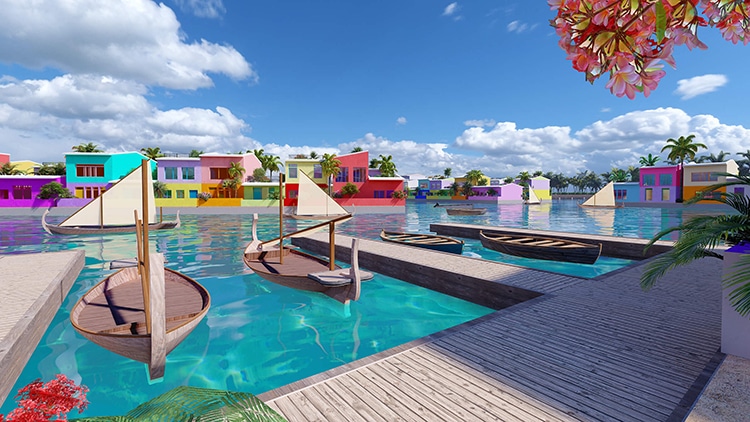

Photo: Waterstudio.NL/Dutch Docklands

A wonderful Pillar at the Center of the Circular City of Gor

 A wonderful Pillar at the Center of the Circular City of Gor

This minar was like a tower which is built in the middle of the Sasanian City of Gor, named Milo Sassanid Ancient Tower. That is very famous among travelers and orientalists. This structure is first found by Pascal Coste and Eugène Flandin. It was a unique tower in Iranian Architecture and is called the legend of Iranian history. That was Alexander, the part of the Persian Territory, defeating its regions and its cities, ending in the capture of the Persepolis in the year of 330 BC.

He constructed a dam in a close-by gorge, keeping the water of the river connected to the plain, where the city is located. That is fully flooding it and making a lake that stayed until the end of the 3rd century AD. After that, king Sassanid Persian tunneled to drain it and destroyed it.

 A wonderful Pillar at the Center of the Circular City of GorThe site of the ancient city of Gor with the pillar at its center. Photo: Amin malekzadeh/Wikimedia

He founded the new capital at the same place, that is called Khor Ardshir or Gor. He made it famous on a circular plan (many centuries before the well-known circular city of Baghdad) with an amazing measurement that the famous Persian writer named Ibn Bakhi wrote that it was designed with a compass.

The diameter was 1,950 meters and was covered by a protective moat 35 meters wide, which could only be avoided using four bridges that provide access to its four gates, and a wall of clay, and each part has cardinal points. The city was distributed into 20 parts by an accurate geometric system of several concentric ones and twenty radical streets.

There is another walled circle inside it, its radius was 450 meters, in which the palaces and the royal buildings were built. The current area that is landscape shows the old setup of the city. The length of the largest tower is 45 meters and its structure remains the same.

 A wonderful Pillar at the Center of the Circular City of GorPhoto: Carole Raddato/Wikimedia


It is called Terbal by Arabs, but according to Persians, they said it as Minaret or Minar like a pillar. The design of this pillar had unique in Persia and an external spiral staircase and it is not the same purpose of it, there are many hypotheses about it. If we calculated its width, it would be around 20 meters adding the destroyed stairs and the outside wall.

The Takht-e-Neshin called the fire Temple and the Minar were the only two designs in the city that are made of granite masonry. The first time a two-person explained the uniqueness of its structure in Persian architecture was a Westerner named Eugene Flandin and Pascal Coste, but another person who explained the systematic study was Ernst Herzfeld. According to him, it is like a stair tower. Before the study of Herzfeld, it is known as Takht-e-Neshin itself, for the prevention of dust contamination, there was a temple with a blessed fire placed on the top.

The opinion of some authors is that it explains the ideology of Ardacher’s state with the symbolized the divine and centralist kingship, and the use of it is very practical, then it showed its visual contact with defenses find the main access road to the plain, in the gorge of Tang-an. The tower is also used as an observation tower, while its work for the plan predicted by Ardacher for the new city and plain was achieved. The whole scheme is centered on the Minar, and the radial pattern and concentric of the city were 10 kilometers away, where traces of roads, canals, and walls have been found.

 A wonderful Pillar at the Center of the Circular City of Gor
Artistic representation of the Minar as a fire temple, drawing by Zenaide A. Ragozin (1889).


A study explained that it may have been a water tower, getting water from nearby sources flowing through the hollow core and the pipes of the minar to its dome, and going to other points in the city.

 A wonderful Pillar at the Center of the Circular City of GorPhoto: akhodadadi/Wikimedia

source  La Brújula Verde


Hector: A Horrible Thunderstorm

 Hector: A Horrible Thunderstorm

A view of Hector from Gunn Point, Northern Territory. Photo: Djambalawa/Wikimedia

In Australia, there are a lot of Irelands, in which Tiwi Irelands are one of them. These

Irelands are the part of Northern Territory. The distance of these Irelands is 80 km to the

north of Darwin and Adjoining the Timor Sea. The combined area of 8,320 square km.

Tiwi Island consists of two Islands. Melville and Bathurst. The people who are living

there are famous for their stunning artwork, passion for football, vibrant textile, and

traditional lifestyle.

A thunderstorm develops in the Tiwi Ireland from September to March every afternoon

in Northern Australia. Meteorologist refers to it as Hector due to its regularity. This

thundercloud called cumulonimbus mostly appears at 3 PM, and according to some

experts, It is so punctual alarm can be set. Another name of Hector is Hector the

Convector, this storm got this name after World War II when the mariners and pilots

used the thunderclouds for navigation purposes. Hector can access immense heights,

some 20 kilometers tall, and it can be seen from Darwin, a distance of 100 kilometers.
 Hector: A Horrible ThunderstormHector as seen from Stokes Hill Wharf in Darwin. Photo: Djambalawa/Wikimedia

The shape, size, and location of Tiwi Island make them an amazing place for the

development of Hector. According to Ben Domensino meteorologist with the

collaboration of a DTN company named Weather zone. The amazing view of the sea

from all sides of Ireland. The cold wind, which is moisture from the sea, needs to go

somewhere when they disturb. The temperature of the air becomes cool when it rises,

and the result of the rising air is water vapors condense and converts to liquid.

Shepherd said that it is common in wet weather where the sea air plays the role

of a lifting trigger, and this weather is a tropical atmosphere. The weather from

September to December is called the build-up session and Hector is commonly found

during the summer. If the temperature increases, it shifts into April. During the late dry

session (In September), winds extending their size from the subtropical ridge to the

south will defeat thunderstorm activity more than in the Northern Territory. And before

the wet session in October and November, the prominent feature of leaving Hector is

the isolated feature on the Darwin skyline. This was the point of view of Lan Shepherd,

who was the senior meteorologist at the Australian Bureau of Meteorology.


The weather of Tiwi Ireland is unexpected and its tropical atmosphere is always

prepared for the formation of a thunderstorm during the wet season when the breeze of

the sea converges and provides the trigger, said, Shepherd.

Hector is also happening during the warm months which is called build-up season from

September to December. Hector is also common in the rainy season from January to

March. Sometimes Hector appears in April if the temperature of the wind is warm

enough.

The one condition when Hector does not appear is when there is a continuous

westerly monsoonal flow.

The cloudy weather and the westerly winds connected with a serious

monsoon tends to suppress sea breezes on all the Irelands, decreasing the

likelihood of Hector forming regularly. According to Shepherd, “An active

monsoon also generates regular showers and thunderstorms which move

rapidly across the islands from west to east in the relatively cool maritime

airstream."

The best time or condition for the hector to occur is when the sky is clear with

a very light wind, this is not only suitable for strong solar heating, and also the

source of daytime sea breezes. In the months of winter from May to August.

There is no chance of Hector and it lowers the strength of the sea breezes.
Source: CNN