Showing posts with label Germany. Show all posts

The Timeless Legacy of Peter Henlein: Unraveling the Story of Watch 1505

The Timeless Legacy of Peter Henlein: Unraveling the Story of Watch 1505

Throughout human history, the concept of timekeeping has evolved from the shadows of sundials to the precision of atomic clocks. But there’s one creation that truly revolutionized personal timekeeping — the world’s first watch, known today as “Watch 1505.” Crafted over 500 years ago, this extraordinary invention marks the beginning of wearable horology and the cultural transformation that followed. Let’s uncover the fascinating story of Watch 1505, its maker, and its timeless influence.Above The Pomander Watch of 1505. Photo credit: Wikimedia Commons

The Dawn of Personal Timekeeping

Before the 16th century, telling time was a communal affair. Tower clocks and sundials served towns and cities, but individuals had no way to carry time with them. The invention of Watch 1505 changed everything. Believed to be created by German locksmith and watchmaker Peter Henlein of Nuremberg around the year 1505, this small, portable clock reshaped how humanity interacted with time.

Henlein’s creation was revolutionary because it was the first timepiece small enough to be worn or carried, powered by a mainspring instead of weights — a radical innovation at the time. It meant time could travel with a person, marking the beginning of a global shift toward personal efficiency and punctuality.

The Timeless Legacy of Peter Henlein: Unraveling the Story of Watch 1505

A statue of Peter Henlein in Nuremberg. Photo credit: Vitold Muratov/Wikimedia Commons

Peter Henlein: The Genius of Nuremberg

Peter Henlein, a craftsman from Nuremberg, Germany, was not just a watchmaker — he was a visionary. In the early 1500s, Nuremberg was a hub for metalworking and mechanical craftsmanship, giving Henlein access to cutting-edge tools and ideas. His invention combined artistic beauty with mechanical brilliance.

Watch 1505 was compact, made of brass, and elaborately designed. It didn’t have the precision we associate with modern watches — it could lose hours a day — but its impact was immeasurable. Henlein’s design laid the foundation for centuries of innovation in clockmaking and established Nuremberg as the birthplace of portable timekeeping.

A Glimpse at Watch 1505 Itself

The Watch 1505 is a spherical, pomander-style timepiece — about the size of a small orange. It is believed to have been worn as a pendant or attached to clothing, making it both a practical and decorative accessory. Its intricate engraving, combined with its clockwork mechanism, reflected the craftsmanship of early Renaissance artistry.

Discovered in the early 21st century and authenticated through detailed research, Watch 1505 is now considered the earliest surviving portable watch. It is not only a technical milestone but also a piece of art that connects the medieval mindset with the dawn of the modern era.

How Watch 1505 Changed the World

The emergence of Watch 1505 didn’t just make time portable; it transformed the rhythm of human life. People could now measure their days with greater precision, leading to new cultural habits around work, prayer, and travel. This marked the beginning of the “age of personal time.”

From that point onward, innovations came quickly — pocket watches became symbols of sophistication in the 17th and 18th centuries, and later, wristwatches evolved into functional fashion. Every smartwatch and chronometer today can trace its roots back to the simple genius of Peter Henlein’s invention.

Cultural and Symbolic Significance

In Renaissance Europe, timekeeping carried deep philosophical meaning. Owning a watch was not just a sign of wealth or status — it was a symbol of mastering time itself. The watch became a metaphor for order, discipline, and progress, aligning perfectly with the intellectual awakening of the Renaissance.

Watch 1505 embodies this spirit — a tangible expression of curiosity, craftsmanship, and the human desire to control the passage of time.

Modern Rediscovery and Legacy

When the Watch 1505 resurfaced in modern times, historians and horologists were fascinated by its authenticity and design. Scientific testing confirmed its age, linking it directly to Henlein’s era. Today, it stands as a testament to early German innovation and is considered one of the rarest and most valuable artifacts in horological history.

Its rediscovery reignited discussions about the origins of modern timekeeping and the ingenuity of 16th-century craftsmanship. Museums, collectors, and historians now regard it as an irreplaceable artifact bridging art, science, and history.

The Enduring Influence on Watchmaking

From Watch 1505 to today’s luxury Swiss brands and digital smartwatches, the philosophy of timekeeping has evolved, but the essence remains the same — precision, craftsmanship, and connection. The spirit of innovation that drove Henlein still fuels the world’s most advanced horological engineers.

Every timepiece, whether mechanical or digital, echoes that same ambition — to bring time closer to the human experience.

A Legacy That Still Ticks

Watch 1505 is more than just a timepiece — it’s a story of human progress. It captures the moment when innovation met artistry and changed how we live our daily lives. Over five centuries later, its ticking still resonates — not in sound, but in spirit — reminding us how one man’s vision reshaped the very nature of time.

The next time you glance at your watch, remember — it all began in Nuremberg, in 1505, with Peter Henlein’s brilliant creation.


The Fascinating Tale of Dresden's "Tobacco Mosque"

The Fascinating Tale of Dresden's "Tobacco Mosque"

 The City of Cultural Paradoxes
In the heart of Dresden, Germany — a city often hailed as the “Florence on the Elbe” for its rich artistic and architectural legacy — stands a structure that continues to fascinate travelers, architects, and historians alike. Known as the Yenidze, or more popularly as Dresden’s Tobacco Mosque, this building defies conventional expectations. What looks like a mosque complete with a grand dome and slender minarets is, in fact, a former tobacco factory. This unique fusion of Eastern design and Western industrial purpose reflects Dresden’s openness to innovation, aesthetics, and global cultural exchange in the early 20th century. Above Photo Credit: QCA7/Wikimedia

Origins: The Tobacco Factory That Didn’t Want to Look Like One
The story of the Yenidze begins in 1907, when entrepreneur Hugo Zietz, owner of a tobacco company, decided to construct a factory in Dresden to produce cigarettes using Oriental tobacco imported from the Ottoman Empire. He named his company “Yenidze”, after the region in modern-day Greece (then part of the Ottoman Empire) where the tobacco originated.

At that time, strict building regulations discouraged the construction of unattractive industrial buildings within the city center. To circumvent these rules, Zietz commissioned architect Martin Hammitzsch to design something visually appealing — and the result was a masterpiece of Oriental Revival architecture. Completed in 1909, the Yenidze stood out as one of the most extraordinary industrial buildings in Europe.

The Fascinating Tale of Dresden's "Tobacco Mosque"

Architectural Marvel: Where East Meets West
The Yenidze’s design draws inspiration from Islamic and Moorish architecture, resembling mosques seen in Cairo or Istanbul rather than German factories. The large dome, constructed from colored glass, gleams under the sunlight, while the corner towers imitate minarets. Yet, beneath this religious façade lay a fully functional industrial plant.

The building’s interior once housed cigarette production halls, storage rooms, and offices — all beneath decorative ceilings adorned with geometric and floral motifs inspired by Islamic art. The contrast between its purpose and its appearance made Yenidze not just a factory but a statement of cross-cultural artistic fusion.

Symbolism and Controversy
For many observers, the Tobacco Mosque symbolized the fascination Europeans had with the “Orient” — a mixture of admiration, curiosity, and exoticism. This architectural style was part of a broader trend in Europe known as Orientalism, where artists and architects drew inspiration from Middle Eastern aesthetics to create romanticized depictions of Eastern culture.

However, some critics viewed the building as an example of cultural appropriation, arguing that the use of religious architectural motifs for an industrial purpose was disrespectful. Yet, others interpreted it as a tribute — a physical manifestation of the global connections that defined early modern commerce and design.

The Fascinating Tale of Dresden's "Tobacco Mosque"

Survival Through War and Destruction
Dresden suffered immense devastation during World War II, particularly in the infamous 1945 bombing raids that destroyed much of the city. Miraculously, the Yenidze survived with only minor damage. Its striking dome and towers remained standing even as the surrounding areas turned to rubble, making it one of the few pre-war landmarks to endure.

After the war, during the East German (GDR) period, the building underwent several transformations. It was used as a warehouse, an office space, and later as a venue for creative industries. Through careful restoration, the Yenidze retained its architectural splendor and historical value.

A New Chapter: From Factory to Cultural Hub
Today, the Yenidze no longer produces tobacco. Instead, it serves as a multi-purpose building housing offices, restaurants, and event spaces. The most notable attraction is the Dome Restaurant, located under the famous glass dome, where visitors can enjoy panoramic views of Dresden while dining amidst the glow of stained glass.

The building also hosts storytelling evenings, concerts, and art exhibitions, making it a symbol of how historical architecture can be reimagined for modern cultural life. It represents both Dresden’s resilience and adaptability, blending the past and present in perfect harmony.


The Fascinating Tale of Dresden's "Tobacco Mosque"


Artistic and Architectural Legacy

Architecturally, the Yenidze remains a case study in how industrial architecture can transcend functionality and become art. Its bold fusion of Islamic forms and European engineering inspired future architects to experiment with cultural motifs in unexpected contexts. The building also holds a unique place in discussions about cultural globalization, showing how trade and design intertwined long before the term “globalization” existed.

Tourist Attraction and Cultural Symbol
For tourists visiting Dresden, the Yenidze is a must-see landmark — not just for its stunning appearance but also for the story it tells about the city’s creative spirit. Whether illuminated at night or gleaming under the sun, the Tobacco Mosque continues to capture imaginations as a symbol of unity through diversity.

Visitors often climb to the rooftop terrace to admire Dresden’s skyline, where the contrast between the Yenidze’s Islamic-inspired dome and the baroque spires of the Frauenkirche creates one of the city’s most photogenic views. This juxtaposition perfectly captures the coexistence of tradition and innovation that defines Dresden’s cultural identity.

The Fascinating Tale of Dresden's "Tobacco Mosque"


Where History, Art, and Commerce Converge

The Yenidze — Dresden’s so-called Tobacco Mosque — stands as more than an architectural oddity. It’s a reminder that beauty and purpose can coexist even in industrial design, and that cross-cultural inspiration can produce works of enduring significance. From its origins as a symbol of global trade to its rebirth as a center of art and storytelling, the Yenidze embodies the idea that architecture can transcend borders, beliefs, and time itself.


In a world increasingly defined by division, the Yenidze continues to offer a quiet yet powerful message: true creativity flourishes when cultures connect rather than collide.


The Fascinating Tale of Dresden's "Tobacco Mosque"

The Enigmatic Wadden Sea: A Natural Treasure of the North Sea

 The Enigmatic Wadden Sea: A Natural Treasure of the North Sea
A group of mudflat hikers on the Wadden Sea near Pieterburen, Netherlands. Photo credit: Wikimedia

The Wadden Sea is not just another stretch of coastline; it’s one of Earth’s most fascinating and dynamic ecosystems. Stretching along the coasts of the Netherlands, Germany, and Denmark, this unique intertidal zone is where the land and sea engage in an eternal dance of tides, wind, and sediment. Recognized as a UNESCO World Heritage Site, the Wadden Sea remains a testament to nature’s resilience and beauty—a living landscape that constantly reshapes itself and sustains a rich tapestry of life.

A Landscape Sculpted by Tides
Unlike most coastal areas, the Wadden Sea is in a state of continuous transformation. Twice each day, the tides reveal vast mudflats, sandbanks, and salt marshes, only to submerge them again under shallow seawater. This rhythmic ebb and flow have shaped the region for thousands of years, creating a unique ecosystem that supports countless species of plants, animals, and migratory birds.
The word “Wadden” comes from the Dutch term “wad,” meaning “mudflat.” These mudflats, though seemingly desolate, are teeming with life. Beneath the surface lies a thriving microcosm of worms, mollusks, and crustaceans—an all-you-can-eat buffet for millions of migratory birds that travel from as far as Siberia and Africa. Each year, the Wadden Sea becomes a crucial refueling station for over 10 million birds, making it one of the most important wetlands in the world.

 The Enigmatic Wadden Sea: A Natural Treasure of the North Sea

Photo credit: in_case_of/Flickr

The Hidden World Beneath the Surface
What makes the Wadden Sea truly extraordinary is its ecological complexity. It’s not just about what’s visible to the eye—the real magic happens beneath the mud. Tiny organisms constantly process nutrients, maintaining the balance of this fragile ecosystem. Algae and plankton provide the base of the food chain, while seals, porpoises, and fish thrive in its shallow waters.
For marine biologists, the Wadden Sea serves as an open-air laboratory, offering invaluable insights into tidal processes, species adaptation, and the effects of climate change. It’s a living classroom that reveals how delicate and interconnected life on Earth truly is.

A Haven for Biodiversity
Despite its harsh conditions—where salinity, temperature, and oxygen levels fluctuate dramatically—the Wadden Sea supports remarkable biodiversity. More than 10,000 plant and animal species have been recorded here, from delicate sea lavender and eelgrass meadows to common seals basking on sandbanks.
Its salt marshes, often overlooked, act as natural barriers against storm surges and coastal erosion, while also providing breeding grounds for birds and nurseries for fish. This intricate balance between land and sea forms one of the last great natural wildernesses in Western Europe.

Human Connection and Conservation Efforts
For centuries, people living along the Wadden Sea coast have depended on its resources. Fishing, oyster farming, and salt extraction were once central to coastal communities. However, these traditional livelihoods often clashed with conservation goals as overfishing and land reclamation began to threaten the delicate ecosystem.
Fortunately, international cooperation has shifted the focus toward preservation. In 2009, UNESCO declared the Wadden Sea a World Heritage Site, acknowledging its global ecological significance. The Wadden Sea Secretariat now oversees collaborative efforts among Denmark, Germany, and the Netherlands to ensure sustainable tourism, habitat protection, and biodiversity monitoring.
This partnership represents a global model for cross-border conservation—a reminder that nature knows no political boundaries.

Challenges in the Modern Era
Despite strong conservation measures, the Wadden Sea faces growing challenges. Rising sea levels, increased storm activity, and human-induced pollution threaten to disrupt its fragile balance. Climate change, in particular, poses an existential risk, altering tidal patterns and eroding habitats.
Plastic waste and chemical pollutants have also infiltrated the food chain, impacting both wildlife and human health. Conservationists argue that maintaining the Wadden Sea’s health requires global awareness and local responsibility. Every small action—reducing plastic use, supporting sustainable seafood, and respecting protected zones—can make a difference.

A Destination Beyond Tourism
While the Wadden Sea attracts tourists for its natural beauty, it offers more than scenic views. Visitors can walk across the exposed seabed during low tide, known as “mudflat hiking,” an otherworldly experience that connects humans directly with the rhythm of nature. It’s not uncommon to see seals lounging lazily on sandbanks or hear the haunting calls of curlews echoing across the flats.
Eco-tourism initiatives have flourished, emphasizing education, sustainability, and respect for wildlife. Guided tours allow visitors to understand the delicate ecosystem while minimizing their impact—a rare opportunity to witness nature’s intricate balance firsthand.

The Deeper Meaning of the Wadden Sea
The Wadden Sea is more than a geographical wonder—it’s a symbol of endurance and harmony between nature and humanity. In a world grappling with environmental degradation, it stands as a living reminder that coexistence is possible when respect, awareness, and stewardship guide our actions.
For those who walk its endless shores or watch the tides sweep across its horizon, the Wadden Sea offers a profound sense of connection. It reminds us that even the most dynamic and shifting landscapes can hold timeless lessons about resilience, adaptation, and renewal.

Conclusion: Nature’s Living Symphony
The Wadden Sea continues to enchant scientists, conservationists, and travelers alike. Its vastness, its rhythm, and its fragile beauty make it one of the most inspiring natural treasures of our planet. To preserve it is to protect not only an ecosystem but also a story of life that has evolved in harmony with the tides for millennia.
In the end, the Wadden Sea teaches us something deeply human—that true strength lies in balance. And as long as the tides continue their eternal dance, this remarkable coastal world will keep whispering its timeless secrets to those who choose to listen.

 The Enigmatic Wadden Sea: A Natural Treasure of the North Sea
 The Enigmatic Wadden Sea: A Natural Treasure of the North Sea
 The Enigmatic Wadden Sea: A Natural Treasure of the North Sea
 The Enigmatic Wadden Sea: A Natural Treasure of the North Sea 
Photo credit: Thijs Knaap/Flickr
 The Enigmatic Wadden Sea: A Natural Treasure of the North Sea
Photo credit: George/Flickr
 The Enigmatic Wadden Sea: A Natural Treasure of the North Sea
Photo credit: George/Flickr
 The Enigmatic Wadden Sea: A Natural Treasure of the North Sea

Photo credit: Alexander Fink/Flickr

The Magnificent F60: A Monument to Industrial Innovation

The Magnificent F60: A Monument to Industrial Innovation
Rising majestically over the quiet landscape of Lichterfeld, Germany, stands a colossal structure that seems straight out of a science fiction movie — the F60 overburden conveyor bridge. Once a vital part of Germany’s mining industry, this massive steel giant now serves as a breathtaking monument to human engineering and industrial history. Nicknamed the “Lying Eiffel Tower,” the F60 stretches an astonishing 502 meters in length, making it one of the largest movable industrial machines ever built.

Today, it no longer digs or transports coal. Instead, it carries a different kind of weight — the legacy of innovation, perseverance, and transformation. The F60 represents how industrial relics can evolve from tools of extraction into symbols of heritage and renewal. Above Photo credit: Gunnar Ries/Wikimedia Commons

From Coal Dust to Engineering Wonder

The F60 was built in the late 1980s as part of East Germany’s ambitious mining operations in the Lusatian lignite region. This area, rich in brown coal, fueled the energy needs of the German Democratic Republic (GDR) for decades. The F60’s purpose was to transport overburden — the layers of soil and rock covering coal seams — from one side of the mine to the other, making way for the extraction of lignite below.

Constructed by the VEB TAKRAF Lauchhammer company, the bridge embodied the peak of industrial efficiency. It combined enormous power with surprising precision, moving thousands of tons of material per hour across the open-cast mine. Measuring longer than five football fields and weighing over 13,000 tons, the F60 was a mechanical marvel — a moving steel landscape that seemed to defy gravity.

A Giant on the Move

To grasp the scale of the F60, imagine an entire skyscraper turned on its side and set in motion. Its towering structure rises nearly 80 meters high, with massive conveyor belts running along its length. Supported by a web of girders and trusses, it could glide gracefully across the mine, powered by electric motors that synchronized its vast components with astonishing precision.

The bridge consisted of several sections: the main conveyor bridge, a counterweight boom, and two auxiliary conveyors. Together, they formed a complex system capable of transferring up to 29,000 cubic meters of overburden per hour. Despite its colossal size, the F60’s movements were so balanced and efficient that it could be controlled by a small team of operators from a central cabin.

It wasn’t just a machine — it was a masterpiece of mechanical choreography.

The Fall of the Mining Era

But history, as always, had other plans. The political transformation following German reunification in 1990 marked the decline of East Germany’s lignite industry. Environmental concerns, economic shifts, and the global move toward cleaner energy sources led to the closure of many coal mines across the region.

The F60 in Lichterfeld, commissioned in 1991, operated for only 13 months before the mine shut down. For such an enormous structure, its active life was astonishingly brief. But its story didn’t end there — what could have been dismantled for scrap was instead preserved as a monument.

Local residents, engineers, and heritage groups recognized the F60’s historical and cultural value. Rather than erasing this colossal symbol of the industrial age, they reimagined it as an industrial monument, transforming the once-polluted mine into a destination for education, tourism, and reflection.

Rebirth as an Industrial Landmark

In 1998, the F60 reopened to the public as part of the Visitor Mine Lichterfeld, under the management of the F60 Förderverein (F60 Association). Today, it stands as both an engineering marvel and a cultural experience. Visitors can walk along its massive structure, guided by experts who share stories of mining life, technological ingenuity, and the workers who powered Germany’s energy revolution.

From its observation platforms, the view stretches across the transformed Lusatian landscape — once black with coal dust, now green with forests and lakes formed from reclaimed mines. The contrast between the past and present is striking. The F60 serves as a bridge not only of steel but also between eras — linking the industrial age with a sustainable future.

Engineering Details That Inspire Awe

Beyond its symbolism, the F60 remains a triumph of design. The structure’s sheer scale pushes the limits of what human engineering can achieve. Its modular design, balance mechanisms, and power systems remain impressive even by modern standards.

  • Length: 502 meters

  • Height: 80 meters

  • Weight: 13,500 tons

  • Operational capacity: 29,000 cubic meters per hour

  • Construction time: Just 22 months

Its components were so precisely engineered that despite its enormous size, the bridge’s operation was smooth and efficient. Each section was designed to distribute weight evenly, ensuring stability across uneven terrain. Engineers often compare it to a “horizontal skyscraper” — both in size and complexity.

The F60 in Popular Culture

Over the years, the F60 has become more than a monument; it’s a stage for creativity. Artists, filmmakers, and musicians have used it as a dramatic backdrop for performances and exhibitions. At night, the structure is illuminated with lights that highlight its geometric beauty, turning it into a glowing sculpture of steel and history.

Its nickname — the “Lying Eiffel Tower” — isn’t just poetic. Much like Gustave Eiffel’s iconic creation, the F60 represents a moment in history when human imagination met the full potential of industrial power. Both structures are testaments to vision and endurance, defying time and changing their purpose without losing their grandeur.

A Lesson in Transformation

The story of the F60 is not only about machines but about people — the miners who worked under its shadow, the engineers who designed it, and the communities that refused to let it vanish into obscurity. It stands as a symbol of transformation, showing how industrial heritage can be preserved and redefined.

Germany’s approach to sites like the F60 reflects a broader cultural trend: turning industrial relics into spaces of learning, art, and tourism. The F60 has become part of the European Route of Industrial Heritage (ERIH), connecting it with other landmarks that celebrate the continent’s technological past.

Environmental Renewal and Sustainable Legacy

Perhaps the most powerful part of the F60’s story is the land that surrounds it. The once-scarred mining pits have been reclaimed, filled with water, and turned into lakes such as Bergheider See. What was once a symbol of environmental degradation is now an example of ecological recovery.

The juxtaposition is profound: a colossal steel bridge standing over green meadows and blue water — a reminder that even the heaviest industries can give way to renewal. It’s an inspiring vision of how humanity can reconcile progress with preservation.

Conclusion: A Bridge Between Eras

The F60 stands today as a towering tribute to the ingenuity and resilience of industrial civilization. Once a machine of extraction, it has become a beacon of transformation. Its immense steel frame no longer echoes with the sound of engines and conveyors but with the footsteps of visitors from around the world.

As we move further into an era defined by sustainability and innovation, the F60 reminds us of an essential truth: progress doesn’t always mean erasing the past. Sometimes, it means reimagining it.

This “Lying Eiffel Tower” of Lichterfeld tells a story that stretches beyond technology — one of human creativity, adaptation, and respect for history. The F60 may no longer move earth, but it continues to move hearts.

The Magnificent F60: A Monument to Industrial Innovation

The Magnificent F60: A Monument to Industrial Innovation
References:
# F60 Overburden Conveyer Bridge, European Route of Industrial Heritage
# Overburden Conveyor Bridge, www.f60.de

Captivating Architecture in Zell, German

Captivating Architecture in Zell, GermanyCaptivating Architecture in Zell (9)This house was built in Germany, in the town called Zell. It was built by Walter Andre and it looks as if it just got out from a fairytale, and everything from its fantastic roof to it’s sandstone windows points in that direction. Many decoration pieces were purchased online and come from several parts of Europe, such as Belgium and Poland.

Stark White Twisting Home in Stuttgart, Germany

Stark White Twisting Home in Stuttgart, Germany
Designed by international architectural firm UNStudio, this single family home is an example of modern architectural stylings with a few added twists. Built in Stuttgart, Germany, the Haus am Weinberg is built in an area that balances the peace of the countryside while still offering sprawling city views.

BMW Museum In Munich, Germany

BMW Museum In Munich, GermanyMunich – the capital of Bavaria, tourists rush to not only see the sculptures, fountains and traditional values, but also to touch the history of the Bavarian automaker. Ignites interest and the fact that the museum was a place near the BMW plant and central office building.
The museum shows BMW's technical development throughout the company's history. It contains engines and turbines, aircraft, motorcycles, and vehicles in a plethora of possible variations. In addition to actual models there are futuristic-looking, even conceptual studies from the past 20 years.

Massive Plastic Roses Installation in Zweibrücken, Germany

Massive Plastic Roses Installation in Zweibrücken, Germany

This massive roses installation is made by German artist Ottmar Hörl.Artist use about 1,000 plastic roses for this installation in the center of town entitled 1,000 Roses for Zweibrücken (2012) at Zweibrücken, Germany.

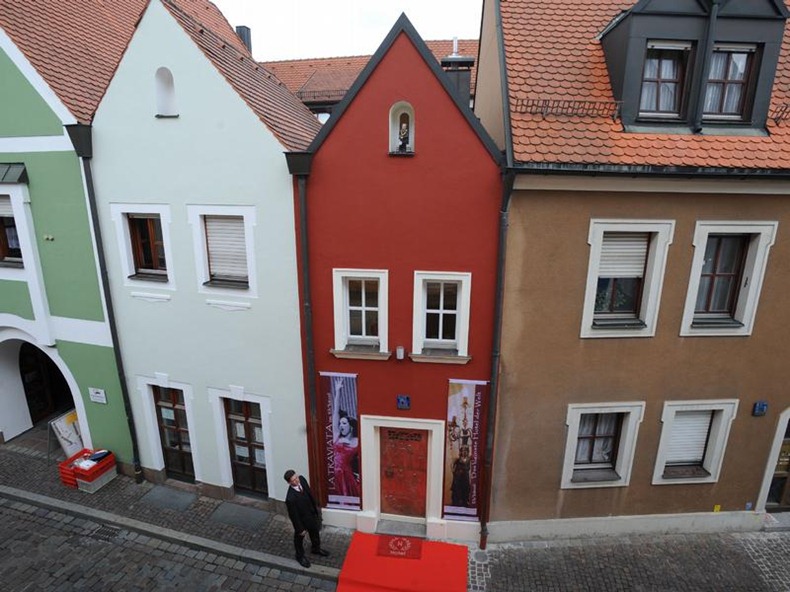
World's Smallest Hotel in Amberg, Germany

 World's Smallest Hotel in Amberg, Germanyehhaeusl
Today, the extraordinary world's smallest hotel in Amberg, Germany is owned by Marina Schreiner,this smallest hotel is just 2.5 meters wide, and occupies a mere 53 square meters of space it became known as Eh'haeusl - or 'the Wedding House'.

Runway Over The Highway In Schkeuditz, Germany

Runway Over The Highway In Schkeuditz, Germany
Leipzig-Halle-airport-0
This unique runway over the highway airport is located at the Schkeuditz, Germany which is known as the Leipzig/Halle Airport.Where three bridges were constructed over the motorway and the tracks, that allowed the parallel runways to extend to their full length of 3.6 km.

Tornado Inside Mercedes-Benz Museum, Germany

Tornado Inside Mercedes-Benz Museum, Germanymercedes-benz-tornado-0 
Have you ever seen the tornado inside the building if your answer is not than it is time to see it in the Mercedes-Benz Museum which is located in the Germany. This artificial tornado height is about  34.4 meter(that is 37.2 yards to those metrically challenged).The 100-feet twister takes around seven minutes to materialize and now this artificial tornado is in Guinness Book of Records as the record "strongest artificially generated tornado in the world."

Amazing Volkswagen’s Car Towers at Autostadt in Wolfsburg, Germany

Amazing Volkswagen’s Car Towers at Autostadt in Wolfsburg,Germany
 This Amazing Volkswagen’s Car Towers at Autostadt is look like a cars museum and this is known as the name Autostadt, 60 meter tall from the ground located at the Volkswagen factory in Wolfsburg, Germany.
autostadt-4
Amazing Volkswagen’s Car Towers at Autostadt in Wolfsburg, Germanyautostadt-3
Amazing Volkswagen’s Car Towers at Autostadt in Wolfsburg, Germanyautostadt-0
Amazing Volkswagen’s Car Towers at Autostadt in Wolfsburg, Germanyautostadt-1
Amazing Volkswagen’s Car Towers at Autostadt in Wolfsburg, Germanyautostadt-2
Amazing Volkswagen’s Car Towers at Autostadt in Wolfsburg, Germanyautostadt-5
Amazing Volkswagen’s Car Towers at Autostadt in Wolfsburg, Germanyautostadt-6
Amazing Volkswagen’s Car Towers at Autostadt in Wolfsburg, Germanyautostadt-7
Amazing Volkswagen’s Car Towers at Autostadt in Wolfsburg, Germanyautostadt-9

Zombie Parade in Frankfurt, Germany

Zombie Parade in Frankfurt, Germany
On July 18, 2009, hundreds of people dressed up and took part in the third zombie parade walking through the city center. Here are some photos takes at the parade.
zombie parade 
Zombie Parade in Frankfurt, Germany
zombie parade (3)
Zombie Parade in Frankfurt, Germany
zombie parade (4)
Zombie Parade in Frankfurt, Germany
zombie parade (5)
Zombie Parade in Frankfurt, Germany
zombie parade (6)
Zombie Parade in Frankfurt, Germany
zombie parade (7)
Zombie Parade in Frankfurt, Germany
zombie parade (8)
Zombie Parade in Frankfurt, Germany
zombie parade (9)